Hair loss is something many people experience at some point in their lives, and for some, it can take a real toll on confidence. Hair loss can be driven by genetics, hormones, stress, or lifestyle factors. The good news is that treatment options have come a long way. In 2026, there are now plenty of prescription and over-the-counter treatment options with easier, more convenient ways to access them through telehealth clinics.
That said, with so many options out there, it is easy to feel overwhelmed and unsure of where to start. To help cut through the noise, we've ranked the best hair loss treatments this year — taking into account clinical guidance, personalized plans, treatment options, and transparency. We break down the pros and cons and offer guidance on how to choose the treatment that may be best suited for you.
Men's hair loss
Male pattern hair loss accounts for 95% of all hair loss in men. But androgenetic causes aren't the only factor — stress, nutrition, age, and genetics each play a measurable role.
The most common cause. Hair follicles become sensitive to dihydrotestosterone (DHT), a hormone derived from testosterone, causing progressive miniaturization until growth stops entirely. Typically presents as a receding hairline and crown thinning.
Genetics, in part, determine how DHT-sensitive your follicles are. If pattern loss runs in your family, you're at an increased risk of developing pattern hair loss.
Even without strong DHT sensitivity, follicles naturally miniaturize with age. Hair becomes progressively finer and shorter from the 30s onward, accelerating through each decade. This process is distinct from but often overlaps with androgenetic loss.
Physical or emotional stress can push large numbers of follicles into a resting phase simultaneously, triggering diffuse shedding up to 2–3 months after the trigger event. Typically reversible, but can unmask or accelerate underlying androgenetic alopecia.
Iron, zinc, biotin, and protein deficiencies all disrupt the hair growth cycle. Rarely the sole cause of significant hair loss in men, but consistently worsen the extent and speed of androgenetic loss when present.
Explore clinically backed treatment options for men — prescription-strength and OTC.
Women's hair loss
Women typically experience diffuse thinning rather than a receding hairline, and the causes are more varied — hormones, autoimmune factors, and nutrition all play distinct roles.
The female equivalent of androgenetic alopecia. Rather than a receding hairline, women see diffuse thinning along the part line and crown. Hormonal sensitivity to androgens is a key driver, though the mechanism differs from the male variant.
Fluctuating hormone levels — during postpartum recovery, perimenopause, and periods of elevated stress or due to thyroid dysfunction — are among the most frequent triggers of female hair loss. Postpartum shedding alone affects up to 50% of new mothers.
An autoimmune condition in which the immune system mistakenly attacks hair follicles, producing patchy, unpredictable hair loss. More common in women than men. Treatment targets immune system modulation rather than hormonal pathways.
Iron deficiency is one of the most overlooked causes of diffuse hair loss in women. Low ferritin, the storage form of iron, impairs the hair growth cycle even before full anemia develops. A ferritin blood test is often the first step in diagnosis.
Women's hair loss has unique causes and unique solutions. Explore targeted treatments curated for women.
Treatment types
In 2026, there is a range of hair loss treatments available, from topical solutions to oral medications, often with different ingredient combinations and formulations. With so many options available, it is important to understand the differences between these treatments and to consult with a medical professional before getting started.
Treatment options may include:
Topical treatments
Typically applied to the scalp, they are often a good starting point and tend to have fewer systemic side effects. Most side effects with topical treatments are localized to the scalp, including irritation, itching, redness, or flaking.
Oral treatments
Usually taken as tablets, capsules, or softgels, maximize convenience, and work systemically. They can be more effective in some cases, but may come with systemic side effects depending on the medication used.
Prescription treatments
Typically used for more advanced hair loss or when over-the-counter options may not have worked. Prescription treatments must be prescribed by a licensed clinician with ongoing monitoring and follow-ups to track safety and effectiveness.
Over-the-counter options
May include topical solutions, shampoos, oils, and supplements — for example, 5% topical minoxidil or saw palmetto oil. These may help support hair and scalp health or address early-stage hair loss; however, results can vary.
Natural ingredients
A growing body of research supports the efficacy of several botanical and peptide-based ingredients in supporting hair growth and reducing shedding — without a prescription. Here are the four categories worth knowing about.
Derived from the berries of the Serenoa repens plant, saw palmetto is one of the most studied natural DHT inhibitors. It works by blocking the 5-alpha reductase enzyme — the same pathway targeted by prescription hair loss medications — reducing the conversion of testosterone to DHT at the follicle level. Clinical studies have shown it can reduce hair loss and improve hair density with a favorable side effect profile compared to pharmaceutical alternatives.
These three patented ingredients are frequently combined in premium OTC formulations because they're clinically studied for supporting hair density and target complementary pathways. Redensyl™ targets stem cells in the hair follicle bulge, reactivating resting follicles. Capixyl™is a biomimetic peptide & red clover extract that strengthens follicle anchorage and reduces scalp inflammation. Procapil™is an antioxidant & peptide complex that improves circulation to the follicle and directly counters the DHT-driven miniaturization process. Together, they address thinning hair at multiple biological stages simultaneously.
Topical caffeine has emerged as a well-supported ingredient for hair retention. Research published in peer-reviewed dermatology journals demonstrates that caffeine penetrates the hair follicle and counteracts the suppressive effects of DHT on hair shaft elongation. It also stimulates keratinocyte proliferation — the cells responsible for hair shaft production — extending the anagen (growth) phase. Topical application bypasses the systemic concerns associated with oral caffeine.
Best known as a sleep hormone, melatonin is also a potent antioxidant. Hair follicles contain melatonin receptors, and topical application has been shown in randomized controlled trials to significantly increase anagen hair rate and reduce telogen shedding. It acts as a potent antioxidant at the follicle level, protecting against oxidative stress — a key driver of hair follicle dysfunction.
Explore products formulated with these evidence-backed ingredients — no prescription required.
Top providers
We evaluated the top hair loss treatment platforms on clinical credibility, product range, pricing, user experience, and real-world outcomes. Here's how they stack up.
When ranking the best hair loss treatments, we focused on the factors that impact safety, results, and long-term success:
We prioritized providers that offer treatments prescribed or approved by licensed clinicians, with proper medical evaluations and access to ongoing clinical support.
Hair loss is not linear and is not one-size-fits-all. The best providers offer tailored treatment plans that are able to change over time as needs change.
Access to a range of options — including oral and topical treatments as well as over-the-counter and prescription options — is essential to fit into individual routines, preferences, and tolerances.
We looked for treatments that include clinically supported ingredients at effective concentrations and avoid unnecessary irritants such as propylene glycol. Clear information about potential side effects is also available from the best providers.
The best providers have clear, upfront pricing with no hidden or surprise fees.
We looked for providers that have easy onboarding, user-friendly platforms, and accessible customer and clinical support.
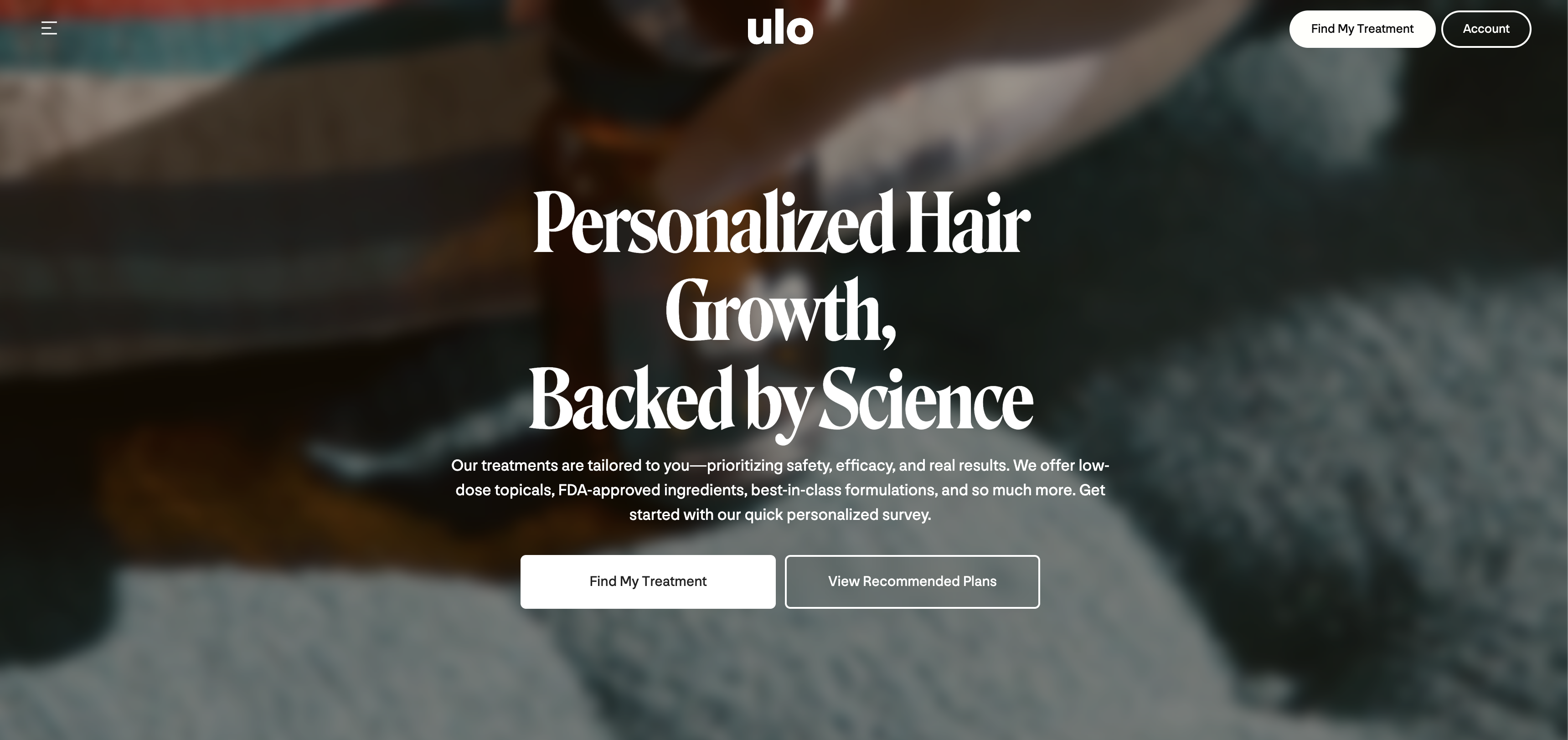
Ulo is the best provider for personalized, medically driven hair loss treatments. They offer a full range of clinically proven treatments, including oral and topical finasteride, minoxidil, and dutasteride, as well as non-pharmaceutical options that include ingredients like saw palmetto. Ulo offers flexible dosing and true customization based on individual needs.
What sets Ulo apart is their focus on transparency, education, and ongoing physician support. Patients have the option to combine treatments with additional ingredients like tretinoin or minoxidil, adjust concentrations over time, and clearly see pricing upfront with no hidden costs. Ulo provides direct access to board-certified physicians and a streamlined online portal for tracking progress and making treatment adjustments.
Hims offers convenient and accessible hair loss treatments. They offer science-backed treatment, including finasteride and minoxidil in a range of formulations, such as sprays, chews, and serums. Hims is best suited for those who value convenience and simplicity.
Hers offers convenient and accessible hair loss treatments. They offer science-backed treatment, including finasteride and minoxidil in a range of formulations, such as sprays, chews, and serums. Hers is best suited for those who value convenience and simplicity.
Blends is a strong option for people who are looking for advanced formulations and access to key hair loss treatments, including dutasteride, finasteride, and minoxidil. Blends' physician-founded background, proprietary gel base, and propylene glycol-free formulations help their treatments stand out.
Strut Health offers a balance between its variety of treatments, pricing transparency, and convenience. Strut offers well-researched treatments at moderate dosages, including finasteride, dutasteride, and minoxidil. Their treatments are alcohol- and preservative-free.
Keeps offers a simple, accessible starting point for men looking for proven hair loss treatments. Keeps offers well-researched treatments, including finasteride and minoxidil. They also provide home delivery and transparent pricing.
Ro offers clinically backed treatments, including finasteride and minoxidil. They also offer combination topical treatments, which include additional ingredients such as tretinoin. Ro offers free shipping and home delivery.
Guidance
The right choice of hair loss treatment depends on factors including the type of hair loss, how advanced it is, and what fits into lifestyle and routine. When considering which treatment may be better suited, it is worth keeping in mind the following:
Different treatment options tend to work better for different conditions. For example, prescription medications, either topical or oral, may be best suited for late-stage androgenic alopecia.
Choosing something you can realistically stick to long term is often more important than the strength of the treatment.
It's important to understand the potential risks and weigh them against the benefits.
Prices between treatments do vary, especially between over-the-counter solutions and prescription options.
Speaking with a healthcare professional can help with choosing the most appropriate treatment for your situation, plus they can help track your progress and make adjustments as needed.
Look out for treatments with ingredients that are backed by credible scientific evidence and have real-world results.
Buyer's guide
When buying hair loss treatments online, price alone does not tell the full story. What matters the most is choosing treatments that are safe, medically supervised, and supported over time — not just convenient or low-cost.
Look out for treatments that:
Are prescribed or approved by a licensed clinician.
Include clear information on ingredients, dosing, and any side effects.
Offer evidence-backed ingredients like finasteride, minoxidil, or dutasteride.
Can be personalized and tailored to your needs.
Have ongoing medical support, follow-up appointments, and treatment adjustments.
Have transparent pricing with no hidden costs or fees.
Final thoughts
Hair loss can feel frustrating, but in 2026, there are now many science-backed and accessible treatment options. Many of these can now be accessed through telehealth providers, with core ingredients like finasteride, dutasteride, and minoxidil forming the foundation of the most effective treatments. What really separates providers today is their level of personalization, medical support, and transparency.
For some, simple and convenient options may be enough to get started. But for others, especially if side effects occur or results plateau, having flexibility and ongoing clinical guidance can make a difference.
There is no single best treatment for everyone. The right choice is one that you can stick to consistently, that fits your lifestyle, and that you feel confident using long-term. If you're unsure where to begin, speaking to a medical professional is a good first step.
FAQs
Is a prescription required for hair loss treatments?
Medications like finasteride, dutasteride, and oral minoxidil require a prescription, as they need medical oversight. Telehealth providers typically connect you with a licensed clinician who can assess your needs and prescribe treatment if appropriate. Other options, such as some topicals, shampoos, and supplements, can be purchased without a prescription.
How long do hair loss treatments take to work?
Most hair loss treatments take months, not weeks, to show results. Generally, results may start within 3 to 6 months, but more noticeable changes often take 6 to 12 months of consistent use. Results tend to vary depending on the treatment, stage of hair loss, and individual responses.
Can hair loss treatments be combined for better results?
Yes, combining treatments may improve results. For example, finasteride and minoxidil work through different mechanisms and can be used together to support hair growth. It is always best to speak with a healthcare provider before combining any treatments to make sure they are safe and appropriate.
Get started
We'll point you to the approach and products best suited to your preference. All questions are required.